Many organizations believe they have an effective asset management strategy simply because they know where their assets are located.
However, knowing an asset's location is only one part of the equation.
As organizations grow across multiple facilities, branches, project sites, and departments, managing assets becomes increasingly complex. Equipment, machinery, tools, IT devices, furniture, and operational infrastructure all require ongoing monitoring, maintenance, and accountability.
This is where many organizations discover an important distinction between asset tracking software and asset management software.
While both are essential for operational visibility, they solve different business challenges.
Understanding the difference can help organizations improve asset utilization, reduce losses, optimize maintenance, and gain complete visibility across the asset lifecycle.
According to the ISO 55000 Asset Management standard, effective asset management is about realizing value from assets throughout their entire lifecycle—not simply knowing where assets are located.
What Is Asset Tracking?
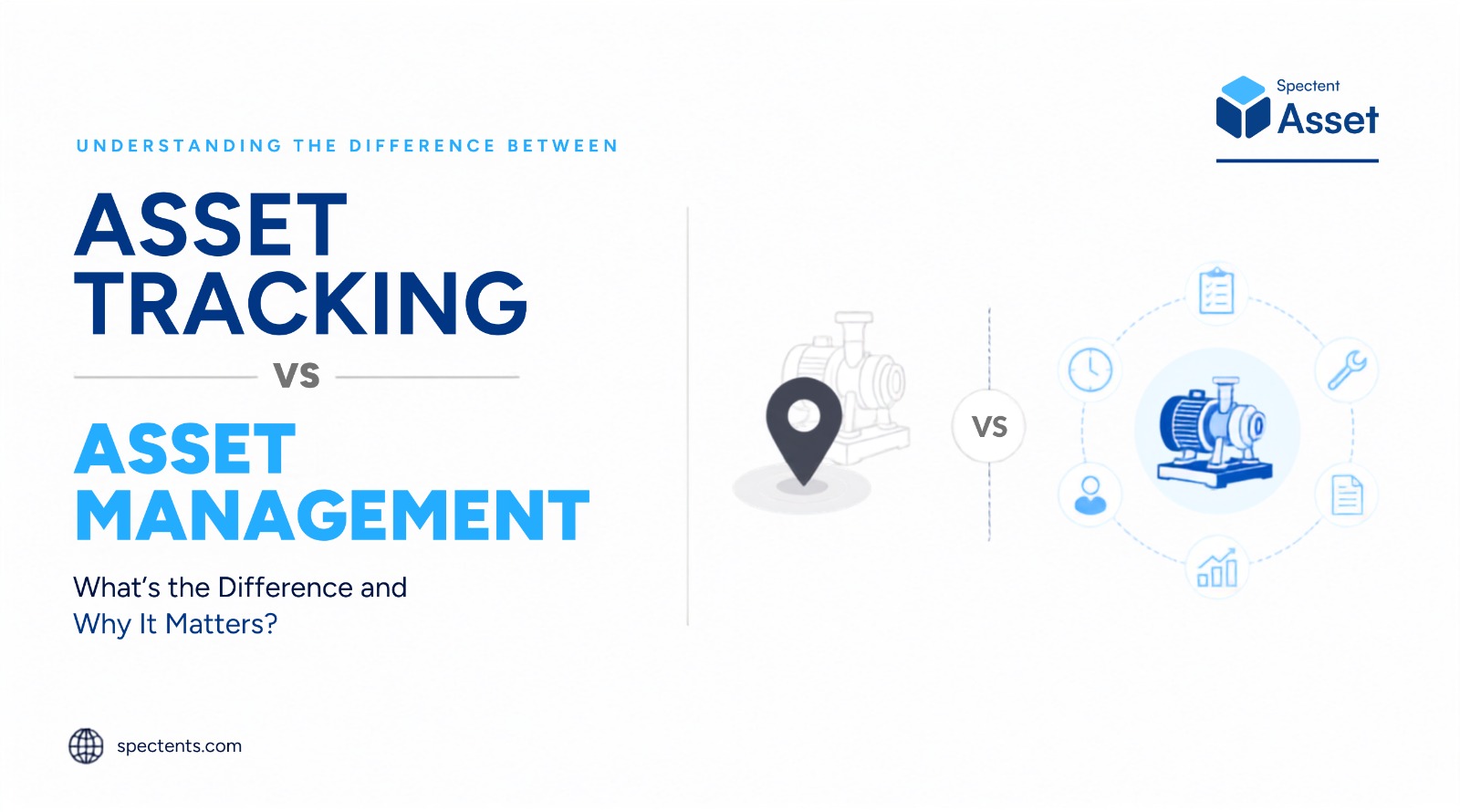
Asset tracking software focuses on identifying and locating assets.
Its primary objective is simple:
"Where is the asset?"
Organizations typically use:
- Barcodes
- QR Codes
- RFID Tags
- GPS Devices
- Asset Labels
to track asset movement and location.
For example:
- A construction company may use asset tracking software to identify which site currently holds a specific excavator.
- A hotel chain may use barcode asset tracking to locate housekeeping equipment across multiple properties.
- A manufacturing company may use tracking systems to monitor equipment movement between production facilities.
Asset tracking provides location visibility and accountability.
However, location alone does not tell the complete story.
What Is Asset Management?
Asset management software goes beyond tracking location.
Its objective is:
"How is this asset performing throughout its lifecycle?"
Modern asset management software provides organizations with complete asset visibility, including:
- Asset Registry
- Asset Ownership
- Asset Movement History
- Maintenance Records
- Inspection History
- Asset Utilization
- Lifecycle Tracking
- Asset Performance
- Compliance Records
- Cost Analysis
Instead of simply knowing where an asset is located, organizations gain complete visibility into how assets are being used, maintained, and managed.
This broader approach is known as asset lifecycle management.
Industry analysts at IBM describe asset management as a lifecycle-based approach that combines tracking, maintenance, performance monitoring, and operational intelligence to maximize asset value and reduce operational costs.
Asset Tracking vs Asset Management: Key Differences
Asset Tracking Software Focuses On:
- Asset Location
- Asset Movement
- Asset Identification
- Asset Verification
Questions it answers:
- Where is the asset?
- Who currently has the asset?
- Has the asset been moved?
Asset Management Software Focuses On:
- Asset Lifecycle Management
- Asset Performance
- Maintenance Planning
- Asset Ownership
- Asset Accountability
- Asset Utilization
Questions it answers:
- Where is the asset?
- Who owns the asset?
- What condition is the asset in?
- When was it last maintained?
- What inspections have been performed?
- What is the asset's maintenance history?
- When should the asset be replaced?
This is why many organizations eventually move from basic asset tracking software to comprehensive asset management software.
Why Asset Tracking Alone Is Not Enough
For small organizations with limited assets, tracking location may be sufficient.
However, larger organizations face significantly greater operational complexity.
Consider a manufacturing company managing:
- Production Equipment
- Utility Infrastructure
- Inspection Devices
- Safety Assets
- Maintenance Equipment
Or a hospitality company managing:
- HVAC Systems
- Kitchen Equipment
- Housekeeping Assets
- Facility Infrastructure
Or a construction company managing:
- Heavy Machinery
- Site Equipment
- Vehicles
- Temporary Infrastructure
In these environments, knowing where assets are located does not help management make informed operational decisions.
Organizations require enterprise asset management capabilities to understand asset health, utilization, maintenance requirements, and operational performance.
According to Deloitte's research on intelligent asset management, organizations are increasingly investing in digital asset management platforms to improve operational efficiency, maintenance planning, and enterprise-wide visibility.
Common Challenges Without Asset Management Software
Limited Asset Visibility
Many organizations know where assets are located but lack visibility into:
- Asset Condition
- Asset Usage
- Maintenance Status
- Asset Ownership
Without centralized asset management software, this information often remains scattered across spreadsheets and departments.
Asset Loss and Misplacement
Without proper accountability, organizations struggle to track asset movement.
This can result in:
- Lost equipment
- Unused assets
- Duplicate purchases
- Increased operational costs
Barcode asset tracking helps improve accountability while supporting broader asset management initiatives.
Reactive Maintenance
Without maintenance history and lifecycle visibility, organizations often repair assets only after failures occur.
Reactive maintenance leads to:
- Operational disruptions
- Increased repair costs
- Equipment downtime
Modern asset management software enables proactive maintenance planning.
Poor Asset Utilization
Many organizations purchase new assets despite existing assets sitting idle.
Without visibility into asset utilization, management cannot optimize asset investments.
Audit Challenges
During audits, organizations often struggle to verify:
- Asset ownership
- Asset location
- Maintenance history
- Inspection records
A centralized asset registry simplifies audit preparation and improves accountability.
Benefits of Asset Management Software
Organizations implementing asset management software gain several operational advantages.
Improved Asset Visibility
A centralized asset management system provides a single source of truth for all organizational assets.
Better Asset Accountability
Clear ownership assignments help organizations reduce asset loss and improve accountability.
Enhanced Maintenance Planning
Historical maintenance records support preventive maintenance strategies and reduce equipment failures.
Improved Asset Utilization
Organizations can make better decisions regarding asset allocation, replacement, and investment.
Stronger Audit Readiness
Complete asset histories improve transparency and simplify audit processes.
How Asset Lifecycle Management Improves Operations
Asset lifecycle management allows organizations to monitor assets from acquisition to retirement.
This includes:
Acquisition
Recording asset details and ownership.
Deployment
Assigning assets to locations and teams.
Operations
Monitoring utilization and performance.
Maintenance
Tracking service history and inspections.
Replacement
Identifying end-of-life assets and planning replacements.
Organizations that adopt asset lifecycle management gain greater operational control while reducing unnecessary costs.
ISO 55000 highlights that organizations adopting lifecycle-based asset management improve decision-making, reduce risk, optimize costs, and maximize long-term asset value.
How Modern Asset Management Software Supports Multi-Site Organizations
Organizations operating across multiple locations require centralized visibility.
Modern asset management software provides:
- Centralized Asset Registry
- Asset Ownership Tracking
- Asset Movement Monitoring
- Barcode Asset Tracking
- Maintenance History
- Inspection Records
- Real-Time Reporting
- Enterprise Asset Management Visibility
This enables management teams to monitor assets consistently across all locations.
How Spectent Asset Helps
Spectent Asset is designed to help organizations move beyond simple asset tracking software and achieve complete asset lifecycle management.
The platform enables organizations to:
- Build a centralized asset registry
- Track asset ownership
- Monitor asset movement
- Maintain inspection and maintenance records
- Improve asset visibility
- Support barcode asset tracking
- Strengthen audit readiness
- Manage assets across multiple locations
By centralizing asset information, Spectent Asset helps organizations improve accountability, reduce operational risk, and make better asset-related decisions.
Conclusion
While asset tracking software helps organizations know where assets are located, asset management software provides complete visibility into how assets are performing throughout their lifecycle.
For growing organizations, location visibility alone is no longer enough.
Organizations need asset management software that supports asset lifecycle management, improves asset visibility, strengthens accountability, and enables better operational decision-making.
Businesses that successfully move beyond basic asset tracking gain greater control over assets, improve maintenance planning, reduce costs, and create a stronger foundation for long-term operational success.