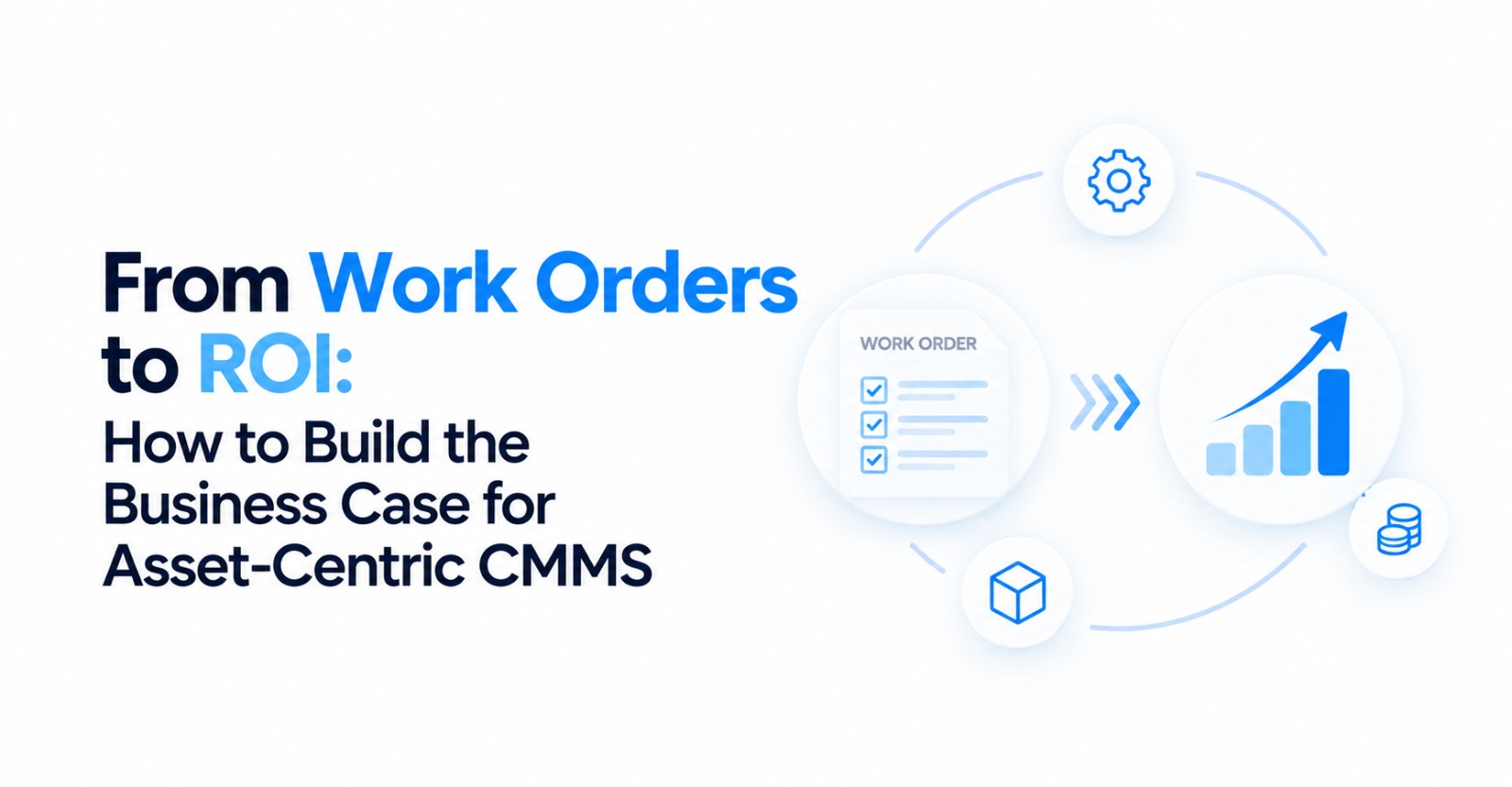
In Part 1, we covered why work-order-first systems are losing ground to asset-centric CMMS platforms in 2026. The "why" is easy for most maintenance leaders to agree with — nobody enjoys running blind on asset health or capital planning.
The harder question is the one finance and ops leadership actually ask: what's the ROI, and how do we switch without disrupting operations?
That's what this piece is for.
Why "It Sounds Good" Isn't Enough for Budget Approval
Maintenance managers often understand the value of asset-centric management intuitively. But intuition doesn't clear a budget committee.
To get buy-in, you need numbers tied to:
- Downtime cost reduction — what unplanned outages are currently costing per hour, per asset
- Preventive maintenance ROI — the delta between planned vs. emergency repair costs
- Capital planning accuracy — fewer premature replacements, fewer surprise failures
- Labor efficiency — technician hours spent chasing information vs. doing repairs
Without this framing, "asset visibility" sounds like a nice-to-have. With it, it becomes a line item finance can defend.
Calculating the Real Cost of Reactive Maintenance
Most enterprises underestimate what reactive maintenance actually costs them, because the expenses are scattered across multiple budgets.
Here's where the money typically leaks:
- Emergency labor and overtime — rush repairs cost more than scheduled ones
- Expedited parts shipping — sourcing under time pressure inflates procurement costs
- Production downtime — lost output during unplanned equipment failure
- Accelerated asset depreciation — assets pushed past safe operating limits fail faster
- Compliance and safety risk — undocumented maintenance history creates audit exposure
An asset downtime cost calculator approach — even a simple spreadsheet mapping these five categories per asset class — is usually enough to make the case internally before you even bring in a vendor.
What a Realistic CMMS Migration Checklist Looks Like
Switching platforms is the part that makes teams hesitate. Nobody wants a six-month rollout that stalls maintenance operations.
A practical CMMS migration checklist looks like this:
- Audit existing asset data — consolidate spreadsheets, legacy CMMS exports, and paper records
- Prioritize critical assets first — migrate high-value or high-downtime-risk equipment before the long tail
- Map ownership and accountability — assign clear asset owners before go-live, not after
- Run a parallel period — keep the old system live for a short overlap window to catch gaps
- Train by role, not by feature — technicians, managers, and finance each need a different view of the same data
Enterprises that skip step 3 are the ones who end up with the exact same accountability gaps in their new system that they had in their old one.
What Changes Operationally After the Switch
Teams that move to an asset lifecycle management platform tend to see the shift play out in a specific order:
- Weeks 1-4: Data consolidation — asset records finally live in one place
- Weeks 4-8: Visibility improves — teams can see asset history and status without digging through tickets
- Months 2-4: Maintenance shifts from reactive to scheduled, based on actual asset condition
- Months 4+: Financial reporting improves — utilization and depreciation data feed directly into capital planning
This is a gradual curve, not an overnight fix — but it's a predictable one, which is exactly what makes it budgetable.
How Spectent Asset Supports the Switch
Spectent Asset is built specifically to make this transition low-friction. Instead of forcing teams to rebuild their asset records from scratch, it centralizes existing data — locations, ownership, maintenance history, and financials — into one platform from day one.
That matters most in three areas:
- Faster time-to-visibility — asset data is structured and searchable immediately, not after months of manual cleanup
- Built-in financial tracking — utilization and cost data are native to the platform, not a bolt-on report
- Audit-ready history from the start — every asset carries a full ownership and maintenance trail, reducing compliance risk during and after migration
For enterprises evaluating enterprise asset management ROI, the platform is designed so the payoff isn't dependent on a perfect, disruption-free rollout — it compounds as more asset data gets centralized.
The Bottom Line
Asset-centric CMMS isn't just a better philosophy — it's a measurable financial decision. Once downtime costs, labor inefficiency, and depreciation risk are quantified, the business case tends to make itself.
The switch doesn't have to be disruptive either, provided the migration is sequenced around critical assets and clear ownership from day one.
Ready to see what the numbers look like for your operation? Spectent Asset can help you map the current cost of reactive maintenance before you commit to a switch.