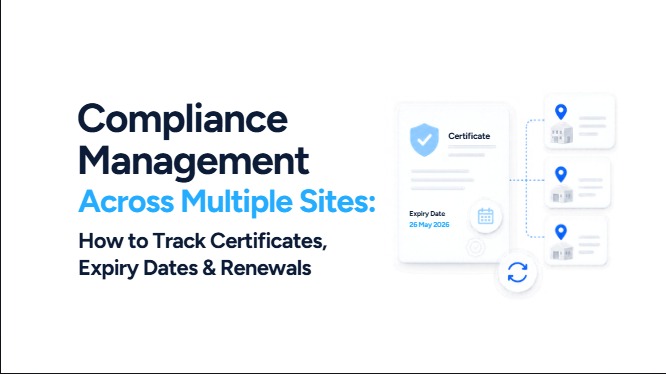
Compliance Doesn't Become Difficult Because There Are Too Many Regulations. It Becomes Difficult Because There Are Too Many Things to Track.
For a single plant, compliance management may already involve dozens of certificates, licenses, inspections, approvals, and renewal obligations.
Now multiply that across 10, 20, or 50 sites.
Suddenly, the compliance team needs to know:
- Which certificates are currently valid?
- Which certificates are about to expire?
- Which ones have already expired?
- When was each certificate last renewed?
- When is the next renewal due?
- Which plant does it belong to?
- Who is responsible for it?
- Which sites are currently compliant?
- Where are the supporting documents?
When this information is spread across spreadsheets, email threads, folders, and physical files, maintaining a clear picture of compliance becomes extremely difficult.
The problem isn't the absence of information.
The problem is the absence of visibility.
What Is Compliance Management?
Compliance management is the process of identifying, monitoring, maintaining, and documenting the regulatory and operational requirements an organization needs to meet.
Depending on the industry and facility, this can include:
- Licenses
- Safety certificates
- Fire NOCs
- Equipment certificates
- Insurance documents
- Environmental approvals
- Calibration certificates
- Electrical safety certificates
- Statutory registrations
- Inspection records
- Permits
- Training certifications
Each requirement can have its own validity period, renewal date, issuing authority, responsible person, and supporting documentation.
Managing all of these manually becomes increasingly difficult as an organization expands.
The Real Challenge: Multi-Site Compliance Visibility
Imagine an organization operating 25 plants across India.
Each plant has its own:
- Fire safety certificates
- Electrical certificates
- Equipment certifications
- Environmental documentation
- Licenses
- Inspection records
- Renewal schedules
A central compliance manager shouldn't have to open 25 spreadsheets to understand the organization's current compliance position.
They should be able to answer one question immediately:
"What is our compliance status across every site right now?"
This is where centralized compliance visibility becomes important.
Compliance Metrics: From Documents to Operational Visibility
One of the biggest improvements technology can bring to compliance management is converting documents and renewal information into measurable compliance metrics.
Instead of simply storing certificates, organizations can track their compliance position across locations.
For example:
| Site | Active | Expiring Soon | Expired | Renewal Pending |
|---|---|---|---|---|
| Plant A | 42 | 4 | 1 | 2 |
| Plant B | 38 | 7 | 0 | 3 |
| Plant C | 31 | 2 | 3 | 1 |
| Plant D | 46 | 1 | 0 | 0 |
A compliance manager can immediately identify where attention is required.
This changes compliance management from document storage to operational intelligence.
What Should a Compliance Dashboard Show?
An effective compliance management system should provide visibility into several important metrics.
1. Active Certificates
How many certificates and licenses are currently valid?
This provides the baseline compliance position.
2. Expiring Certificates
Which certificates are approaching their expiry date?
Early visibility gives teams time to initiate renewal instead of reacting at the last minute.
3. Expired Certificates
Which compliance documents have already expired?
These should be immediately visible so responsible teams can take corrective action.
4. Renewal Status
Track whether a certificate is:
- Not due
- Renewal upcoming
- Renewal initiated
- Renewal pending
- Renewed
- Expired
This provides visibility into the complete renewal lifecycle.
5. Site-Wise Compliance
Compare compliance status across different plants, facilities, branches, or operational locations.
This is particularly valuable for organizations with distributed operations.
6. Compliance Trends
Historical compliance data can help organizations understand whether compliance performance is improving or deteriorating over time.
Why Certificate Expiry Tracking Matters
Certificate expiry is one of the simplest compliance risks to prevent—and one of the easiest to overlook.
A certificate might be valid today but expire in 20 days.
If the renewal process takes several weeks, waiting until the expiry date creates unnecessary risk.
A good compliance tracking system should therefore make upcoming expirations visible well before the deadline.
For example:
Certificate: Electrical Safety Certificate
Site: Plant B
Expiry: 18 September 2026
Renewal Status: Pending
Responsible Person: Electrical Safety Manager
This gives the team enough context to take action.
Compliance Management Across Plants
For organizations operating multiple locations, centralized visibility becomes even more important.
A corporate compliance team can view:
Organization Level
Overall compliance status across the company.
↓
Site Level
Compliance position for each plant or facility.
↓
Certificate Level
Individual certificate validity and renewal status.
↓
Document Level
The actual certificate, supporting documents, inspection records, and renewal history.
This creates a connected compliance hierarchy rather than isolated spreadsheets.
How Spectent Helps Create Compliance Visibility
Spectent's compliance capabilities are designed around a simple principle:
Don't just store compliance information. Make its status visible.
With Spectent, organizations can maintain compliance information across multiple sites and monitor the status of certificates and renewals from a centralized system.
Centralized Compliance Records
Maintain certificates, licenses, permits, and other compliance documents in a structured digital repository.
Each record can be associated with the relevant:
- Site
- Plant
- Asset
- Compliance requirement
- Responsible person
Certificate Expiry Tracking
Track certificate validity and identify documents that are:
- Active
- Approaching expiry
- Expired
- Under renewal
This makes upcoming compliance obligations easier to identify.
Renewal History
Maintain information about previous renewals so teams can understand:
- When the certificate was issued
- When it was renewed
- Previous expiry dates
- Current validity
- Renewal status
This creates a complete historical record rather than just showing the latest document.
Multi-Site Compliance Metrics
Instead of checking each location individually, management can view compliance metrics across different sites.
This makes it easier to identify:
- High-risk sites
- Expired certificates
- Upcoming renewals
- Compliance gaps
- Sites requiring immediate attention
Compliance Ownership
Compliance isn't useful if nobody owns the action.
Assign responsibility to relevant employees or teams so that renewal and corrective activities have clear ownership.
Compliance Should Be Proactive, Not Reactive
A traditional compliance process often looks like this:
Certificate expires → Team discovers it → Renewal starts → Risk increases
A proactive process looks different:
Expiry approaching → Team gets visibility → Renewal initiated → Certificate renewed → Compliance maintained
The difference is visibility.
When compliance information is centralized and measurable, teams can act before a problem becomes an operational risk.
From Compliance Documents to Compliance Intelligence
The future of compliance management isn't simply replacing physical files with PDFs.
It's about turning compliance information into actionable operational data.
Instead of asking:
"Where is the certificate?"
Organizations should be able to ask:
"Which certificates are expiring in the next 30 days?"
"Which plants currently have compliance gaps?"
"Which renewals are still pending?"
"Which certificates have already expired?"
"Who owns the renewal?"
"How has our compliance status changed over time?"
These are the questions that a modern compliance management system should answer.
Conclusion
Managing compliance across a single facility can be challenging. Managing it across multiple plants, sites, and operational locations requires a completely different level of visibility.
Certificates, licenses, permits, inspections, and renewals cannot remain isolated in spreadsheets and folders.
Organizations need a centralized view of what is compliant, what is expiring, what has expired, what is under renewal, and where action is required.
Spectent helps organizations move from document-based compliance management to centralized compliance visibility, giving teams a clearer view of compliance status across sites and helping them stay ahead of expiry and renewal requirements.
Because compliance shouldn't be discovered after something expires. It should be visible before it becomes a problem.
FAQ
What is compliance tracking?
Compliance tracking is the process of monitoring regulatory requirements, certificates, licenses, inspections, expiry dates, renewals, and corrective actions to ensure an organization remains compliant.
How do you track certificate expiry dates?
Organizations can maintain a centralized register containing certificate details, issue dates, expiry dates, responsible owners, renewal status, and supporting documents. Digital compliance software can automate this tracking and provide visibility into upcoming and expired certificates.
How can companies manage compliance across multiple plants?
A centralized compliance management system can organize requirements by site and provide organization-wide metrics, allowing compliance teams to monitor individual plants as well as overall compliance status.
What should a compliance dashboard include?
A compliance dashboard should typically include active certificates, expiring certificates, expired certificates, renewal status, site-wise compliance metrics, ownership, and historical compliance trends.
What is the difference between compliance management and document management?
Document management focuses primarily on storing and organizing documents. Compliance management goes further by tracking requirements, validity, expiry dates, renewals, ownership, status, and actions associated with those documents.