Running a restaurant chain is as much an operational discipline as it is a culinary one. Behind every successful outlet lies an intricate system of inventory control, supplier coordination, workforce planning, and asset maintenance , all of which must function in sync for the business to remain profitable.
Yet for many restaurant chains across India, these systems remain fragmented, manual, and reactive.
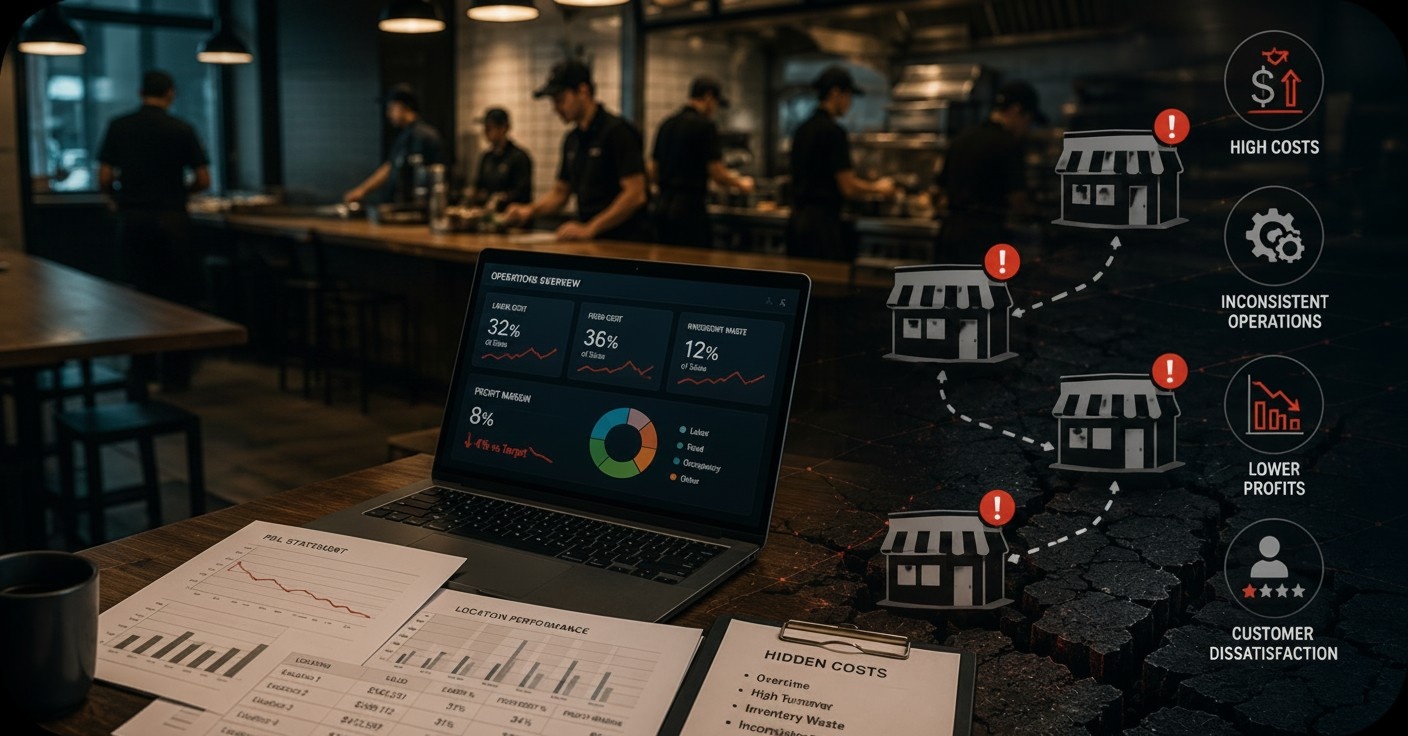
Industry observations indicate that a mid-sized restaurant outlet generating ₹25–60 lakh in monthly revenue can lose anywhere between ₹1.5 lakh to ₹3.5 lakh every month , not due to low footfall or poor product quality, but due to compounding operational inefficiencies that often go undetected until significant damage is done.
This article examines where those losses originate, and what a shift toward operational clarity can deliver.
1. Inventory Management: Where Margins Begin to Erode
For many restaurant chains, inventory is still managed through spreadsheets, messaging apps, or end-of-day manual counts. While this may appear functional in the short term, it creates a persistent vulnerability.
Overstocking leads to spoilage and write-offs. Understocking results in missed sales and inconsistent customer experiences. Without real-time visibility, purchasing decisions become reactive rather than strategic.
In India, the ideal food cost benchmark sits between 28–35% of revenue. However, chains operating without structured inventory systems frequently see this figure climb to 40–45% , a deviation that does not merely reduce margin, it can eliminate it entirely.
The shift from manual tracking to real-time inventory intelligence allows operators to move from instinct-based ordering to data-backed decision-making , reducing waste, improving consistency, and protecting margins.
2. Supply Chain & Vendor Coordination: The Cascading Risk
Restaurant chains depend on timely, accurate supplier deliveries. When vendor management is fragmented , relying on phone calls, informal follow-ups, and undocumented agreements , the risk compounds quickly.
Delayed deliveries disrupt kitchen operations. Miscommunications result in incorrect or incomplete orders. Emergency procurement, while solving the immediate problem, consistently drives up the cost per unit.
Perhaps more importantly, without centralized tracking, there is no visibility into vendor performance over time , making it impossible to identify recurring issues, hold suppliers accountable, or make informed decisions about partnerships.
Structured supply chain visibility transforms procurement from a reactive function into a predictable, manageable one.
3. Labor Allocation: The Cost of Misalignment
Labor represents one of the largest and most controllable cost centers in restaurant operations. Yet without operational data to guide scheduling, staffing decisions tend to rely on intuition and historical habit rather than actual demand patterns.
The result is predictable: overstaffing during slow periods, understaffing during peak hours, and an ongoing drain on productivity through manual coordination and unplanned firefighting.
Industry benchmarks place prime cost , the combined total of food and labor , at 60–65% of revenue for a well-run operation. In fragmented environments, this number rises steadily, compressing profitability with each percentage point.
Aligning workforce deployment with real demand data is one of the most direct levers available to improve operational efficiency.
4. Energy & Utilities: The Overlooked Expenditure
Energy consumption is among the least visible line items in restaurant operations , and, consequently, one of the most undermanaged.
Equipment running beyond required hours, inconsistent usage patterns across locations, and aging appliances operating at reduced efficiency all contribute to avoidable utility costs. These expenses rarely trigger immediate concern, but they accumulate steadily and are seldom traced back to their root cause until billing spikes force attention.
Proactive monitoring of energy consumption enables early identification of inefficiencies, reduces unnecessary expenditure, and supports better equipment lifecycle planning.
5. Asset Management: The Most Underestimated Gap
Every restaurant operates on a foundation of critical equipment , refrigeration units, cooking appliances, HVAC systems, POS hardware, and more. The reliability of these assets directly determines the reliability of operations.
Yet in many chains, asset management remains entirely reactive. Maintenance occurs only after failure. Equipment histories are stored in informal logs or not at all. There is no proactive scheduling of servicing, no visibility into asset health, and no system to anticipate replacement needs.
The consequences are significant: unexpected breakdowns during peak service hours, elevated emergency repair costs, shortened equipment lifespan, and direct revenue loss from operational downtime. When layered on top of existing inefficiencies, unmanaged assets become a substantial and often invisible contributor to monthly losses.
A structured asset management approach , one that maps, monitors, and maintains every piece of equipment proactively , converts unpredictable failures into manageable, scheduled maintenance.
From Fragmentation to Operational Control
When multi-location businesses move from disconnected, manual processes to a centralized asset platform, the impact is both immediate and compounding:
- Asset visibility becomes absolute, eliminating blind spots across locations and giving teams a single, structured source of truth.
- Lifecycle control becomes proactive, streamlining everything from allocation and movement to maintenance and status tracking.
- Financial and utilization intelligence becomes clear, revealing the true value, depreciation, and actual cost of every asset.
- Accountability becomes permanent, ensuring full history tracking, clear ownership mapping, and constant audit readiness.
- Assets are maintained proactively, minimizing downtime and extending their useful life.
The fundamental shift is not merely technological — it is operational. Managers stop spending their time responding to crises and start spending it managing systems.
The transition is from reaction to control, from guesswork to intelligence, from compounding losses to measurable improvement.
Closing Perspective
The restaurants that struggle to scale rarely do so because of insufficient demand. More often, the limiting factor is invisible , inefficiencies embedded in daily operations that compound quietly over months and years.
The gap between a struggling outlet and a scalable chain is often not product quality or market opportunity. It is operational clarity , the ability to see what is happening across the business, act on that information in real time, and build systems that perform consistently at every level.
That clarity is available. The question is when to pursue it.