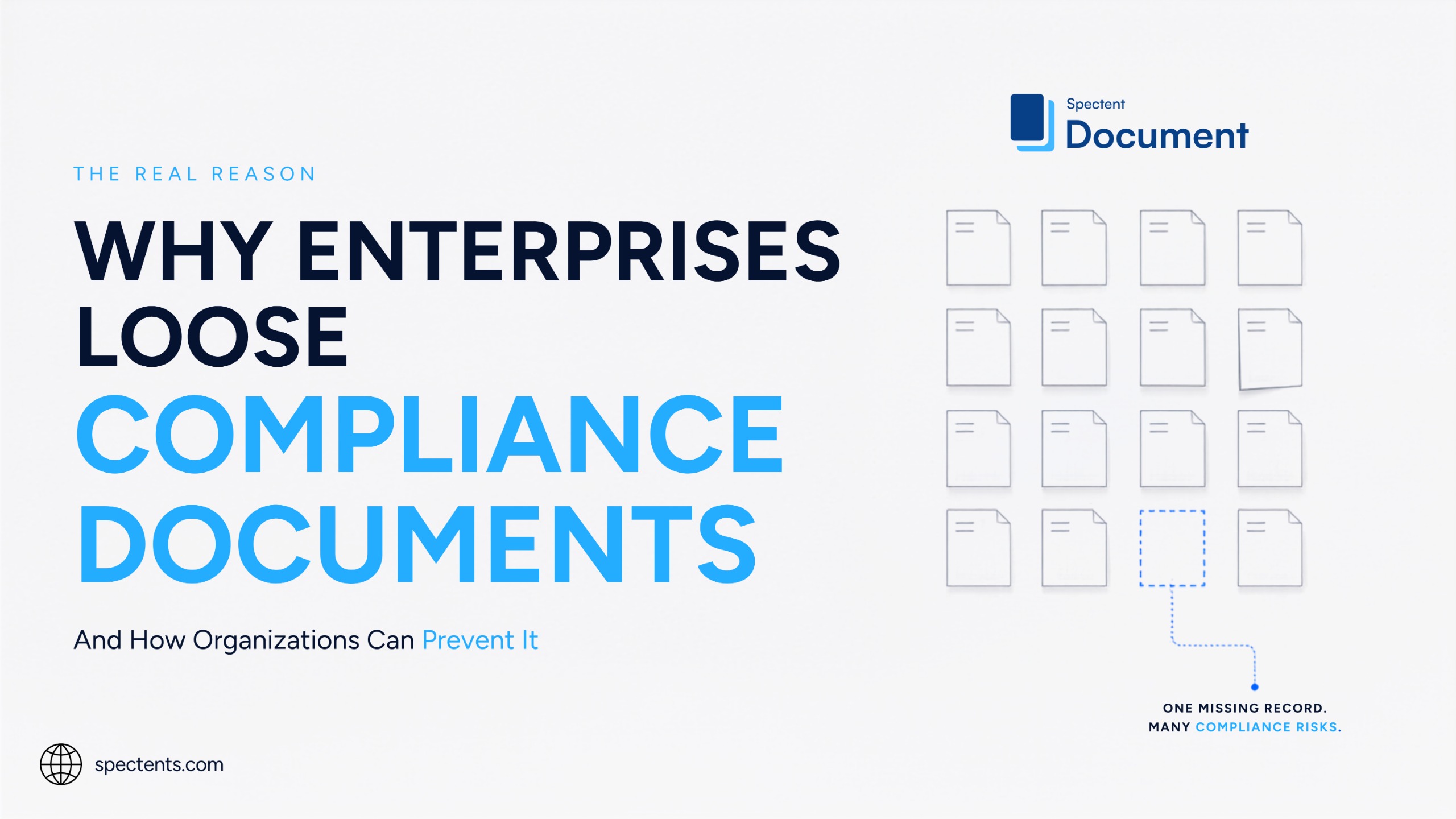
Most organizations don't fail audits because they lack compliance documents.
They fail because they cannot find the right compliance document when they need it.
As businesses grow across multiple locations, departments, and teams, managing compliance documents becomes increasingly complex. Certificates, licenses, permits, inspection records, SOPs, policies, and regulatory documents are often stored across shared drives, spreadsheets, email threads, and physical folders.
Without a structured compliance management software solution, organizations struggle to maintain visibility over their compliance documentation.
The result?
- Missed renewals
- Delayed audits
- Compliance risks
- Countless hours spent searching for information
The problem isn't document creation.
The problem is compliance visibility.
According to ISO 37301:2021 (Compliance Management Systems), organizations should establish structured compliance processes, maintain documented information, and ensure clear ownership to effectively manage compliance obligations as they grow.
Why Compliance Documents Get Lost
Information Is Scattered Across Multiple Systems
One of the biggest reasons compliance documents get lost is fragmentation.
Many organizations store compliance-related information across:
- Shared network drives
- Personal desktops
- Cloud storage platforms
- Email attachments
- Physical filing cabinets
Without a centralized document management software platform, teams often spend significant time locating documents.
As the number of locations and compliance obligations increases, visibility decreases. Research from Deloitte's Global Risk Management Survey highlights that fragmented systems and disconnected data remain one of the biggest barriers to effective governance, risk management, and compliance.
Compliance Tracking Is Managed Manually
Many businesses still rely on spreadsheets for compliance tracking.
While spreadsheets may work initially, they become difficult to manage as compliance requirements expand.
Manual tracking often leads to:
- Missed deadlines
- Incomplete records
- Duplicate documentation
- Lack of accountability
Modern compliance management software eliminates these risks by automating compliance tracking and document monitoring.
Ownership Is Not Clearly Defined
A common challenge in compliance operations is unclear ownership.
Questions such as:
- Who owns this document?
- Who updates this certificate?
- Who tracks renewal dates?
- Who maintains regulatory records?
often remain unanswered.
Without clear ownership, compliance documents become outdated, misplaced, or forgotten.
Version Control Creates Confusion
Organizations frequently maintain multiple versions of the same document.
This creates confusion during audits and compliance reviews.
Employees may reference:
- Old policies
- Expired certificates
- Outdated SOPs
- Incorrect regulatory records
A centralized document management software system ensures teams always access the latest approved version. ISO Managed's Document Control Best Practices recommend maintaining controlled document versions, approval workflows, and revision histories to ensure employees always work with the latest approved documentation.
Audit Preparation Becomes Reactive
Many organizations only organize compliance documents when an audit is approaching.
This reactive approach results in:
- Last-minute document collection
- Increased administrative effort
- Missing evidence
- Higher compliance risk
Organizations using compliance management software remain audit-ready throughout the year.
The Business Impact of Poor Compliance Visibility
When compliance documents are difficult to locate, organizations face more than administrative inconvenience.
The consequences can include:
Regulatory Penalties
Missing compliance records can lead to penalties and non-compliance findings.
Failed Audits
Without proper documentation, organizations struggle to demonstrate compliance during audits.
Operational Delays
Teams spend valuable time searching for documents rather than focusing on operational priorities.
Increased Compliance Risk
Missed renewals and incomplete records increase exposure to compliance-related risks.
Reduced Accountability
Without centralized compliance tracking, ownership and responsibility become difficult to establish.
Why Compliance Management Software Matters
As organizations grow, manual systems become increasingly difficult to manage.
This is why businesses are adopting compliance management software to centralize compliance operations and improve visibility.
Effective compliance management software helps organizations:
- Centralize compliance documents
- Track obligations
- Monitor renewals
- Improve audit readiness
- Assign ownership
- Maintain document history
- Reduce compliance risks
Rather than relying on fragmented systems, organizations gain a single source of truth. ISO 37301 emphasizes that effective compliance management relies on documented information, clearly assigned responsibilities, monitoring mechanisms, and continual improvement across the organization.
How Compliance Management Software Improves Audit Readiness
Audit readiness is one of the biggest benefits of modern compliance management software.
Instead of collecting documents at the last moment, organizations maintain structured compliance records year-round.
This allows teams to:
- Retrieve documents instantly
- Track compliance status
- Verify ownership
- Access historical records
- Demonstrate accountability
When auditors request evidence, the information is already available. According to BOC Group's Compliance Management Guide, organizations that centralize compliance documentation and standardize governance processes are significantly better prepared for audits and regulatory reviews.
Best Practices for Preventing Lost Compliance Documents
Create a Centralized Compliance Repository
Store all compliance-related documentation within a single system.
A centralized repository improves visibility and accessibility.
Assign Clear Ownership
Every compliance document should have an assigned owner responsible for updates and maintenance.
Automate Compliance Tracking
Avoid manual spreadsheets wherever possible.
Automated compliance tracking improves consistency and reduces human error.
Maintain Document History
Version control and document history ensure teams always reference approved records.
Monitor Renewals Proactively
Track:
- Licenses
- Permits
- Certifications
- Regulatory obligations
before expiration dates approach.
How Spectent Document Helps
Spectent Document is designed to help organizations centralize compliance operations through a modern compliance management software platform.
The platform enables organizations to:
- Create a centralized compliance repository
- Manage compliance documents
- Track obligations and renewals
- Improve audit readiness
- Monitor document ownership
- Maintain compliance visibility across locations
- Access AI-powered document assistance
By bringing compliance data into a single platform, organizations gain greater control over compliance operations while reducing risk.
Conclusion
Compliance documents rarely disappear because they were never created.
They become difficult to find because they are scattered across systems, managed manually, and lack visibility.
As compliance requirements continue to grow, organizations need more than document storage.
They need compliance management software that provides visibility, accountability, and audit readiness.
Organizations that centralize compliance documentation, automate compliance tracking, and establish ownership are better positioned to reduce risk, improve operational efficiency, and maintain continuous compliance.
The goal is not simply to store compliance documents.
The goal is to ensure every compliance document is accessible, traceable, and audit-ready when it matters most.